
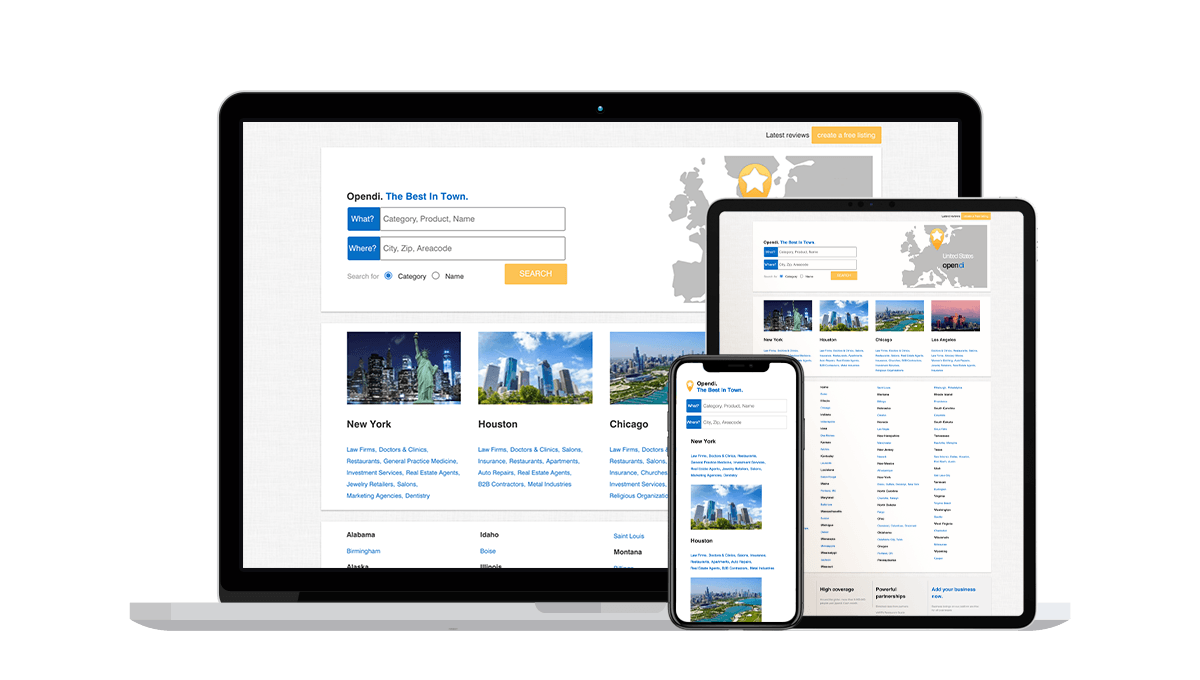
Opendi is not a freelancing marketplace where buyers post projects and wait for proposals. It is an international local-business directory and review network. That distinction matters: the platform can help you discover businesses, but winning a client still depends on research, qualification, and personalized outreach.
According to the official Opendi business directory, the network operates directories and review platforms in 36 countries and reports 66.5 million business entities, 2.5 million reviews, and about 4.5 million monthly visitors. These figures make it a potentially useful starting point for finding local companies that may need SEO, website content, guest posting, link building, digital PR, web design, or reputation-management support.
| Quick answerYes, you can use Opendi to find potential clients. Treat it as a prospecting database—not as a source of guaranteed or verified leads. Always confirm the business is active, visit its website, validate the contact information, and identify a real marketing gap before sending an offer. |
What This Guide Covers
- What Opendi is and how it works
- The complete list of countries currently shown by Opendi
- What business data may be available in listings
- The best client types for SEO, content writing, guest posting, and web services
- A step-by-step lead-generation workflow
- How to qualify prospects and write personalized outreach
- Limitations, accuracy checks, and responsible use
- Frequently asked questions and publishing references
What Is Opendi?
Opendi is a group of country-specific online directories that lets users search for businesses by category, product, company name, city, ZIP code, or area. Depending on the country and the individual record, a listing may contain basic contact details, a business description, opening hours, website links, categories, reviews, and location information.
For marketers, the value is not only the listing itself. Opendi can help you build a targeted prospect list by combining three filters: country, city, and business category. A broad search such as “companies in the United States” is usually too weak. A focused search such as “roofing contractors in Dallas” or “estate agents in Manchester” gives you a clearer market, a relevant service offer, and a more personalized outreach angle.
Opendi Is a Directory, Not a Client Marketplace
This is the most important expectation to set. Businesses on Opendi have not necessarily asked to receive proposals. You will not see public job budgets, project descriptions, hiring deadlines, or buyer accounts as you would on Upwork or another freelance marketplace. Instead, you identify companies that appear to have a need, research them independently, and contact the right person through a publicly available business channel.
Opendi at a Glance
| Officially reported metric | Current figure shown by Opendi |
|---|---|
| Countries | 36 |
| Business entities | 66.5 million |
| Reviews | 2.5 million |
| Monthly visitors | 4.5 million |
Source: Opendi International AG, official international directory page, reviewed August 5, 2026.
Which Countries Are Available on Opendi?
Opendi’s official international page currently links to 36 country directories. Some markets use the Opendi brand directly, while Austria, Germany, and Switzerland also use Stadtbranchenbuch-branded directory domains. The country selection is spread across Europe, Oceania, Asia, North America, Central America, South America, and Africa.
| Region | Countries listed by Opendi |
|---|---|
| Europe (19) | Austria, Belgium, Denmark, France, Germany, Italy, Netherlands, Norway, Poland, Spain, Sweden, Switzerland, United Kingdom, Finland, Portugal, Romania, Turkey, Hungary, and Luxembourg. |
| Oceania (2) | Australia and New Zealand. |
| Asia (4) | India, China, Hong Kong, and Japan. |
| North America (3) | Canada, Mexico, and the United States. |
| Central America / Caribbean (1) | Puerto Rico. |
| South America (6) | Brazil, Argentina, Chile, Panama, Peru, and Venezuela. |
| Africa (1) | South Africa. |
Country list verified against Opendi’s official international directory page. Availability and domains may change over time.
Best Countries to Target First
The “best” country depends on your language, service, pricing, timezone, and ability to understand the local market. For English-language outreach, the United States, United Kingdom, Canada, Australia, and New Zealand are practical starting points. For multilingual outreach, Germany, France, the Netherlands, Switzerland, Sweden, Norway, Denmark, Italy, Spain, and other European markets can also provide valuable prospects.
Do not choose a country only because it appears wealthy. A smaller, tightly defined niche with a clear service need can outperform a huge list of unrelated companies. For example, 100 carefully researched dental clinics with outdated websites may be more valuable than 5,000 unqualified businesses from mixed categories.
What Business Data Can You Find on Opendi?
The information varies by country, category, source, and listing completeness. Opendi explains that its coverage combines public-record imports with partner publication data. A partner technical page from Yext shows that the Opendi publishing integration can support a broad range of fields, but this does not mean every public listing contains every field.
| Data group | Possible listing fields |
|---|---|
| Core identity | Business name, category, description, and sometimes logo or photos. |
| Contact data | Main phone, mobile phone, email, website, and sometimes fax. |
| Location data | Street address, city, postal code, map coordinates, route or map link, and service-area details. |
| Operating information | Opening hours, holiday hours, payment methods, reservation links, menu links, or order links where relevant. |
| Online presence | Website, Facebook, X/Twitter, images, videos, and other partner-supplied profile details. |
| Trust signals | Ratings, reviews, business descriptions, and listing completeness. |
| Important data-quality noteA listing may be incomplete, duplicated, outdated, automatically imported, or missing an email address. Never treat directory data as fully verified. Confirm the company’s current website, location, services, and contact details before outreach. |
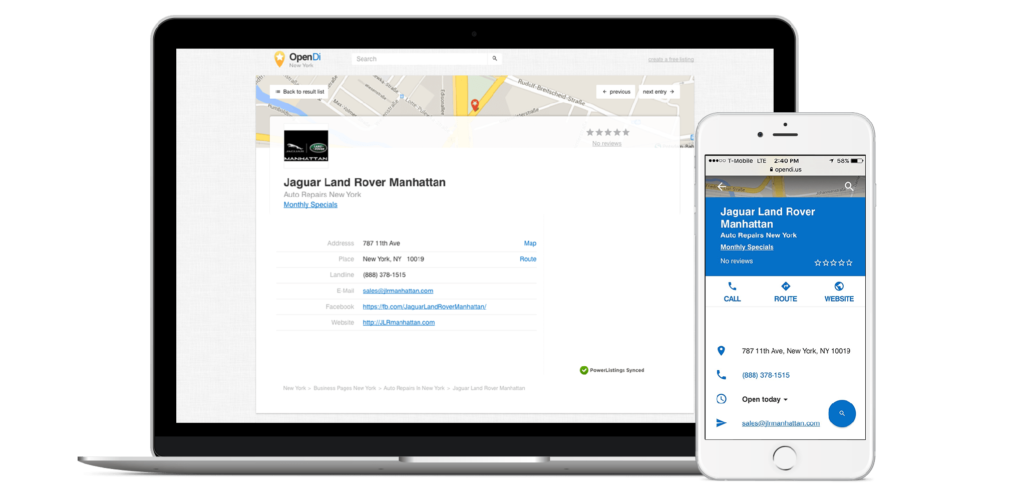
Example of a detailed Opendi listing shown on desktop and mobile. Image source: Yext publisher integration page.
Can You Really Find Clients on Opendi?
Yes—but the correct phrase is “find prospects,” not “find guaranteed clients.” Opendi can help you identify businesses that fit your ideal customer profile. Your own research then determines whether each company has a problem you can solve, whether it can afford your service, and whether you can reach a relevant decision-maker.
The platform is especially useful when your service is tied to local visibility or website performance. A business with a weak website, missing service pages, an inactive blog, poor location targeting, inconsistent contact information, or limited authority signals may be a reasonable prospect for SEO and content-related services.
Best Client Types for SEO, Content, Guest Posting, and Web Services
| Client segment | Examples | Relevant services to pitch |
|---|---|---|
| Local home services | Roofers, plumbers, HVAC contractors, electricians, cleaners, landscapers, pest-control companies | Local SEO, service pages, city pages, review strategy, citations, backlinks |
| Professional services | Law firms, accountants, consultants, financial professionals, recruitment firms | Authority content, practice/service pages, digital PR, guest posting, conversion copy |
| Healthcare | Clinics, dentists, physiotherapists, medical practices, healthcare professionals | Local landing pages, educational content, technical SEO, reputation support |
| Real estate | Estate agents, property managers, brokers, builders, commercial real-estate firms | Location content, property-market articles, local links, lead-generation pages |
| Hospitality and food | Hotels, restaurants, cafes, caterers, event venues | Local SEO, menu/location optimization, reputation content, seasonal campaigns |
| Automotive | Repair shops, dealers, detailing services, tyre shops, rental companies | Service-page SEO, location targeting, review visibility, link acquisition |
| B2B and technology | Software firms, IT providers, agencies, manufacturers, business services | Thought leadership, technical content, SaaS/B2B backlinks, white-label outreach |
| Beauty and wellness | Salons, spas, cosmetic clinics, gyms, massage and wellness providers | Local SEO, service descriptions, content, reputation and social-proof pages |
Step-by-Step: How to Find Qualified Clients Using Opendi
1. Define one ideal client profile
Choose one country, one city or region, one industry, and one service offer. Example: independent law firms in Texas that need content and authority backlinks.
2. Open the correct country directory
Start from the international Opendi website and select the relevant country directory. Country-specific domains may use a local language and different category structure.
3. Search by category and location
Use a service category plus a city, ZIP code, or region. Avoid collecting every business. Focus on a niche where your offer is easy to explain.
4. Build a clean prospect sheet
Record business name, Opendi listing URL, website, phone, public email, city, category, review count, decision-maker clues, and a short note about the possible need.
5. Visit the official website
Check whether the domain works, the business is active, the service is relevant, and the location matches. Review the homepage, services, blog, contact page, title tags, and overall credibility.
6. Identify a real marketing gap
Look for specific evidence: no blog, thin service pages, outdated design, missing location pages, weak calls to action, slow mobile experience, inconsistent NAP information, or limited authority content.
7. Prioritize leads
Score prospects by fit, visible need, business quality, reachable contact channel, and probable budget. Contact high-fit prospects first rather than sending the same message to everyone.
8. Find the right contact person
Look for the owner, marketing manager, practice manager, operations manager, or agency partner through the company website and professional networks.
9. Send a short personalized message
Mention one observation, explain one likely impact, and offer one clear next step. Do not send a long generic audit to every business.
10. Track and follow up
Use a CRM or spreadsheet to record the date, channel, reply, follow-up date, and outcome. Stop contacting people who opt out or show no interest after a reasonable sequence.
A Simple Lead-Qualification Score
A lightweight score prevents you from wasting time on businesses that are inactive, irrelevant, or unlikely to buy. Give each prospect 0, 1, or 2 points for the following five factors:
- Service fit: Does the business clearly need the service you sell?
- Visible need: Can you point to a specific content, SEO, website, or authority gap?
- Business legitimacy: Is the company active, professional, and reachable?
- Budget signal: Does the website, team size, location, or service value suggest purchasing capacity?
- Contactability: Can you identify a relevant person or reliable business contact channel?
Score 8–10 as high priority, 5–7 as medium priority, and 0–4 as low priority. This is not a guarantee of conversion; it is simply a consistent way to order your outreach queue.
What Should You Offer Different Opendi Prospects?
| Observed gap | Relevant service offer |
|---|---|
| No blog or very old blog | Monthly content writing, topic strategy, content refresh, internal linking |
| Few useful service pages | SEO service-page copy, city/location pages, conversion-focused landing pages |
| Low authority or few relevant mentions | Guest posting, authority link building, digital PR, expert contributions |
| Inconsistent business details | Local citation audit, NAP cleanup, listing management, Google Business Profile support |
| Good content but weak discoverability | Technical SEO, on-page optimization, content consolidation, schema and internal links |
| Outdated or unclear website | Website redesign, messaging, conversion copy, mobile UX improvements |
| Agency or marketing firm | White-label content, guest-post placements, link outreach, overflow SEO support |
Personalized Outreach Template
| Subject: Quick idea for [Business Name]’s online visibilityHi [Name], I found [Business Name] while researching [industry] companies in [city]. I noticed that [specific, accurate observation]. This may make it harder for potential customers to understand or discover [service/location]. We help businesses improve this through [relevant service]. I can send a short three-point plan based on the pages I reviewed—would that be useful? |
The template works because it is short and evidence-based. Replace every bracketed section with real information. Avoid negative or insulting statements, exaggerated promises, fake urgency, and claims that you can guarantee rankings.
How to Start Your Research
Begin at the Opendi international directory homepage, choose the target country, and then narrow your research by category and location. Create a prospecting sheet before contacting anyone so the same company is not approached repeatedly by different team members.
Limitations and Risks You Should Understand
- Not every listing is complete: Some records contain only a name, address, or phone number, while others include richer details.
- Directory data can become outdated: Businesses move, close, change websites, update phone numbers, or rebrand.
- A listed business is not automatically a buyer: The company may already have an agency, lack budget, or have no current marketing priority.
- Mass outreach reduces quality: Generic messages are easier to ignore and can damage your brand reputation.
- Automation requires safeguards: If you use a browser extension or scraper, respect the site’s terms, rate limits, robots rules where applicable, and local privacy and anti-spam requirements.
- Metrics require independent verification: Do not claim traffic, rankings, backlink quality, or technical problems without checking reliable tools and the actual website.
Research Methodology and E-E-A-T Notes
This guide was prepared by reviewing Opendi’s official international page, its published country links, FAQ information about listing sources and updates, and a current publisher-integration page describing supported listing fields. The article separates verified platform facts from practical marketing recommendations and clearly labels prospecting as an inference rather than a guaranteed outcome.
For publication, strengthen experience and trust by adding the real author’s name, professional role, short biography, LinkedIn profile, and a brief disclosure of any hands-on test performed. A useful test could document one niche, one city, the number of listings reviewed, how many active websites were found, and the percentage with usable contact channels. Publish only genuine results—do not invent a case study.
| Editorial accuracy policyPlatform statistics, country availability, and listing features can change. Recheck the official Opendi page before major updates, date the article clearly, and revise any figure that no longer matches the source. |
Frequently Asked Questions
Is Opendi free to use for finding businesses?
Public directory search is generally available without paying for a freelance buyer account. Listing and management options can vary by country and partner setup.
Does Opendi provide verified email addresses?
Not necessarily. Some listings may display an email, but you should verify that it belongs to the active business and is appropriate for outreach.
Can I scrape all Opendi data automatically?
Technical possibility is not the only consideration. Review the applicable terms, use reasonable request rates, avoid collecting unnecessary personal data, and comply with privacy and outreach rules in the target country.
Which country is best for finding clients?
For English-language services, the United States, United Kingdom, Canada, Australia, and New Zealand are practical starting markets. The best market is the one where you can communicate well and offer a relevant solution.
What services are easiest to sell to Opendi prospects?
Local SEO, service-page content, location pages, website copy, guest posting, authority link building, citation cleanup, reputation support, and web design are natural fits for many local businesses.
Is Opendi better than Google Maps for lead generation?
They serve different purposes. Google Maps often has richer current local signals, while Opendi can provide another discovery source and may surface businesses or directory records you did not identify elsewhere. Strong research usually combines more than one source.
How many emails should I send?
Quality matters more than volume. Start with a small, well-qualified batch, measure replies, improve the offer, and respect opt-outs instead of relying on bulk generic outreach.
Final Verdict
Opendi can be a useful lead-research source for freelancers and agencies because it organizes millions of business entities across 36 countries by local market and category. Its strongest use case is focused prospecting: choose one niche, collect a manageable list, validate every business, identify a real problem, and send a personalized offer.
It should not be treated as a database of people who have requested marketing proposals, and its records should not be assumed to be complete or current. The professionals most likely to get results are those who combine directory discovery with website analysis, accurate qualification, ethical outreach, and a service offer connected to a specific business need.
About the Publisher
| B2BUsingAI Editorial TeamB2BUsingAI publishes practical research on AI tools, B2B client acquisition, freelancing, marketing platforms, SEO, content workflows, and agency growth. Before publishing, replace this generic team bio with the real author’s name, credentials, and professional profile to improve transparency and E-E-A-T. |