

| Quick answer“SEO instant appear” should be understood as faster discovery and indexing—not a guaranteed first-page ranking. The most defensible approach is to remove crawl/index barriers, submit eligible URLs through Search Console, maintain accurate sitemaps, strengthen internal linking, publish people-first content, and then earn ranking signals over time. |
The search phrase seo instant appear highsoftware99.com has started appearing across SEO-focused pages and discussions, usually in the context of getting new or updated content noticed by search engines faster. That makes the topic useful—but it also creates room for confusion. Fast discovery, indexing, and ranking are separate stages, and no platform can force Google to place a page at the top of competitive results on demand.
This guide takes a verification-first approach. It explains what the phrase can reasonably mean, how Google actually handles crawling and indexing, which actions can legitimately speed up discovery, and which claims should be treated with caution. The goal is not to repeat marketing language. It is to give website owners a checklist they can use before paying for any “instant appearance” SEO service.
What Does “SEO Instant Appear HighSoftware99.com” Mean?
In practical SEO terms, “instant appear” is best interpreted as shortening the time between publishing a page and making that page discoverable, crawlable, indexable, and eligible to appear for relevant searches. It is not the same as instant ranking. Google’s own documentation makes this distinction clear: a URL can be indexed and still not appear prominently because ranking depends on relevance, quality, context, and many other signals.
Public material associated with the HighSoftware99 brand frames the concept around technical indexability, Search Console submission, sitemap optimization, content quality, structured data, entity signals, and visibility in AI-powered search experiences. Those components overlap with legitimate modern SEO work. The key question is not whether the checklist contains familiar SEO tasks; it is whether the service executes them safely, transparently, and with realistic expectations.
Indexing Is Not Ranking: The Distinction That Matters Most
A new page generally moves through a sequence. First, a search engine needs to discover the URL. Next, it crawls the page and evaluates whether the content is accessible and eligible for indexing. If indexed, the page becomes a candidate for relevant queries. Ranking happens after that, when search systems compare the page with alternatives and decide when and where it should appear.
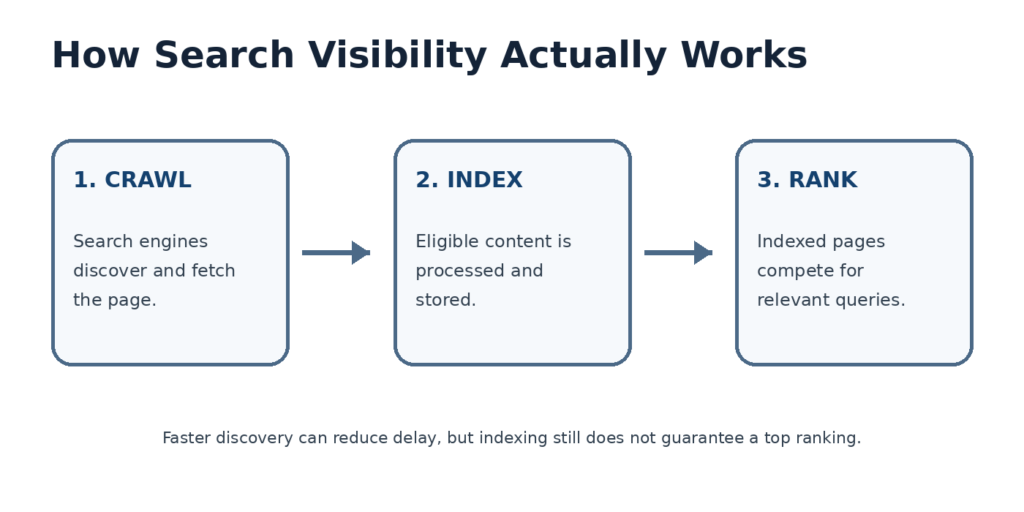
Crawling → indexing → ranking. Improving the first two stages can reduce delays, but it does not guarantee a specific position.
This sequence prevents a common SEO mistake: treating “indexed” as a synonym for “ranking.” Google Search Console’s URL Inspection tool can report that a URL is on Google, but Google explicitly notes that this does not guarantee the page will be shown for a particular search. That outcome depends on query relevance, quality, competition, location, language, device, and other systems.
What Can Legitimately Help a Page Appear Faster?
There is no universal instant-index button, but site owners can remove avoidable delays. The following actions are aligned with Google’s published guidance and are useful whether or not you use a third-party SEO service:
- Make sure the page returns a normal 200 response, is not blocked by a noindex directive, and is accessible to crawlers.
- Add the URL to a clean XML sitemap and keep the sitemap updated when important pages change.
- Link to new pages from relevant, already-discovered pages so crawlers can reach them through normal site navigation.
- Use Search Console’s URL Inspection tool to test a priority URL and request indexing when appropriate.
- Keep canonical tags consistent so search engines are not asked to index one URL while another version is declared canonical.
- Improve page experience, mobile usability, rendering, and load performance so search bots and users can access the main content reliably.
- Publish genuinely useful content that answers the search intent instead of creating thin pages only to target keyword variations.
| Important technical cautionGoogle’s Indexing API is not a general-purpose shortcut for ordinary blog posts. Google currently limits it to pages containing JobPosting structured data or livestream pages with BroadcastEvent embedded in a VideoObject. For normal articles and service pages, use standard crawling, sitemaps, internal links, and Search Console. |
How to Evaluate HighSoftware99.com Without Guessing
If you are researching HighSoftware99.com because of the “instant appear” phrase, evaluate the platform like any other SEO provider: by asking for evidence, scope, method, reporting, and limitations. A credible provider should be able to explain exactly what will be changed on your site and which outcomes it can—and cannot—control.

Treat brand-specific SEO promises as claims to verify against your own Search Console data and published search-engine guidance.
What Evidence Should You Ask For?
Before accepting a performance claim, ask for evidence that connects the provider’s work to measurable outcomes in your own accounts. The table below shows the kind of proof that is more useful than a generic success statement.
| Claim to check | What good evidence looks like |
| “We get pages indexed faster” | Before/after Search Console screenshots, sample URLs, crawl dates, and clear methodology. |
| “We improve rankings” | Query-level ranking history, traffic changes, landing-page performance, and enough time to separate SEO work from normal volatility. |
| “We optimize for AI search” | Specific content/schema changes, tracked brand citations or mentions, and a clear explanation that AI visibility is not guaranteed. |
| “100% white-hat” | No hidden link networks, automated search manipulation, cloaking, scraped pages, or attempts to abuse indexing systems. |
| “Guaranteed instant results” | Treat absolute ranking guarantees as a warning sign; ask exactly what is guaranteed and under what measurable condition. |
The E-E-A-T Layer: Why Fast Indexing Alone Is Not Enough
Google describes helpful content in terms of people-first usefulness and encourages publishers to make authorship, sourcing, experience, and expertise clear. E-E-A-T stands for experience, expertise, authoritativeness, and trustworthiness. It is not a single numeric ranking factor, but Google says its systems use multiple signals that can identify content demonstrating these qualities, with trust being especially important.
For a blog trying to earn durable search traffic, that means every indexing tactic should sit on top of a stronger content foundation. A page that is crawled quickly but offers nothing new may still perform poorly. A slower-discovered article with original analysis, accurate sourcing, clear authorship, useful examples, and good internal support has a better long-term chance of satisfying readers and search systems.
- Show who wrote or reviewed the article and link the byline to a meaningful author profile.
- Explain how conclusions were reached, especially in reviews, comparisons, or tool evaluations.
- Link important factual claims to primary or authoritative sources rather than anonymous reposts.
- Add original observations, screenshots, tests, examples, templates, or data when you have them.
- Update content when the underlying product, policy, interface, or search guidance changes.
- Avoid claiming first-hand testing if the product or service was not actually used.
A Safe 7-Step “Appear Faster” Workflow for a New Article
- Publish one strong canonical URL with a descriptive title, clean slug, useful introduction, and complete answer to the search intent.
- Check indexability: status code, robots directives, canonical tag, rendered main content, and mobile accessibility.
- Add relevant internal links from category pages and already-performing articles. Avoid orphan pages.
- Update the XML sitemap and confirm Search Console can read it.
- Inspect the URL in Search Console. If the live test is indexable and the page is important, request indexing.
- Monitor the Page Indexing report and Performance report instead of repeatedly submitting the same URL.
- Improve the article based on impressions, query data, engagement, competitor gaps, and new evidence rather than chasing artificial “instant” signals.
What to Avoid
Speed becomes risky when it turns into manipulation. Avoid services that depend on artificial searches, click farms, hidden redirects, mass-generated doorway pages, irrelevant backlink bursts, or misuse of restricted indexing systems. Even if such tactics create a temporary signal, they do not build the trust, relevance, or user value needed for sustainable organic growth.
Also avoid publishing dozens of near-identical pages around small keyword variations. Google’s people-first guidance warns against mass-producing content mainly to attract search visits. If multiple keywords share the same intent, one comprehensive page is usually more useful than a cluster of thin duplicates.
Does SEO Instant Appear HighSoftware99.com “Work”?
The answer depends on what “work” means. If the goal is to remove crawl barriers, improve site structure, submit priority URLs correctly, strengthen internal links, and improve content quality, those are legitimate SEO tasks that can help search engines discover and process pages more efficiently. If the promise is guaranteed top rankings immediately after submission, that expectation is not supported by how Google describes Search.
For that reason, the most useful way to judge seo instant appear highsoftware99.com is not by the phrase itself. Judge it by the actual work performed, the transparency of the process, the quality of the content improvements, and the evidence visible in your own analytics and Search Console account. Faster crawling can be valuable; durable ranking still requires relevance, quality, authority, and time.
Frequently Asked Questions
Can a page appear on Google instantly?
Sometimes a page can be discovered or indexed quickly, especially on an established site, but Google does not guarantee a specific indexing time. Search Console requests place eligible URLs into a queue; inclusion is not guaranteed.
Is being indexed the same as ranking?
No. Indexing means Google has processed and stored the URL as eligible for Search. Ranking determines whether that URL is shown for a specific query and at what position.
Should I request indexing every time I edit a page?
Usually no. Search engines recrawl pages naturally. Use URL Inspection for important updates or troubleshooting; for many pages, maintain a sitemap and strong internal linking.
Can I use Google’s Indexing API for normal blog posts?
Google currently limits the Indexing API to qualifying JobPosting pages and livestream pages using BroadcastEvent inside VideoObject. It is not intended as a general fast-indexing API for ordinary articles.
What should I ask an SEO provider before buying?
Ask for a precise scope of work, access requirements, examples, reporting method, backlink policy, technical changes, content process, expected timeline, and a written explanation of any guarantee.
What is the best way to improve long-term visibility?
Combine technical indexability with people-first content, strong internal architecture, credible sourcing, author transparency, natural authority signals, and continuous improvement based on real search data.
Final Verdict
The phrase “SEO instant appear” is useful when it focuses attention on a real problem: some pages stay invisible because search engines cannot discover, crawl, interpret, or trust them efficiently. Fixing those barriers can shorten the path to visibility. But speed should never be confused with a ranking guarantee.
If you are considering HighSoftware99.com or a similar service, use the same standard you would use for any serious SEO investment: verify the method, insist on measurable reporting, avoid manipulative shortcuts, and evaluate results through your own Search Console and analytics data. The strongest SEO strategy is not the one that promises the fastest result; it is the one that improves discoverability while building content and trust signals that can survive algorithm changes.